



Why It Matters

Budgets Drive Growth
Tie spending directly to revenue goals.

Complexity Demands Clarity
Multi-location brands need alignment across corporate and local.

Performance is Proof
Show ROI with measurable, data-driven tactics.

2026 Raises the Stakes
AI shifts and economic pressure make smarter planning non-negotiable.

ABOUT THE AUTHOR
Budget Season 2026: How to Plan Smarter Marketing Budgets
As 2026 approaches, marketing leaders face the annual challenge of budget season. But this year, the pressure is even greater: economic uncertainty, rising competition, and evolving digital channels make it harder than ever to decide where—and how much—to invest. The key to success lies in building a budget that balances proven performance with innovation, ensures accountability, and supports both corporate and local marketing needs.
Why Budget Season 2026 Matters More Than Ever
Budget planning is no longer just about “what you can afford.” For multi-location and franchise brands, it’s about aligning spend with measurable outcomes. Investors and executives want to see ROI, while local teams expect marketing support that drives leads and customer engagement. A well-structured 2026 marketing budget ensures you can meet growth goals without wasted spend. As McKinsey notes, brands that continue to invest strategically in marketing during uncertain times build resilience and often outperform competitors who cut spend.
How Much Should You Spend on Marketing in 2026?
Most businesses dedicate 5–10% of annual revenue to marketing, with higher-growth brands investing even more. For multi-location and franchise systems, budgets must also account for national branding, local lead generation, and technology investments like customer data platforms (CDPs).
Key budget drivers for 2026 include:
- Performance marketing channels (SEO, paid media, direct mail)
- AI-powered targeting and personalization
- Brand governance across locations
- Customer experience optimization
The Role of Performance Marketing in Budget Planning
Performance marketing is critical during budget season because it ties every dollar directly to outcomes. Instead of relying on vanity metrics, you can measure leads, conversions, and ROI in real time. With tools like the AdScience® Growth Engine, marketing leaders can connect campaigns and spend directly to customer outcomes.
Where to allocate precious budget funds matters more than ever in 2026.
Performance marketing in 2026 will include:
- SEO & Answer Engine Optimization (AEO): Ensuring your brand is discoverable in search, AI assistants, and SGE results.
- Paid Media & Direct Mail: Targeting the right audiences with measurable campaigns.
- Attribution via AdScience®: Connecting marketing spend to customer actions, from leads to revenue
Budget Benchmarks for Multi-Location & Franchise Brands
Franchise and multi-location businesses face unique challenges during budget season. Corporate teams must balance the efficiency of centralized campaigns with the flexibility local owners need to compete in their markets. For many multi-location brands, the largest share of spend goes to lead generation activities such as paid search, SEO, and direct mail.
Typical budget allocations in 2026:
- 40–50% on lead generation (paid search, SEO, direct mail, social)
- 20–25% on brand building (content, creative, PR)
- 15–20% on customer retention (email, loyalty programs, CRM)
- 10–15% on technology and analytics (platforms like AdScience™ and Pylot®)
5 Steps to Build a Smarter 2026 Marketing Budget
Prioritizing performance channels ensures you not only generate demand but also convert leads to customers efficiently.
- Start with Revenue Goals: Align spend to growth targets, not last year’s numbers.
- Benchmark by Industry: Compare against competitors in home services, retail, restaurants, and other sectors.
- Prioritize Performance Channels: Focus on strategies with proven ROI, like SEO, PPC, and direct mail.
- Invest in Technology: Use CDPs, analytics, and AI-driven tools to gain visibility and improve targeting.
- Measure & Adjust Quarterly: Don’t lock budgets in stone—reallocate based on campaign performance.
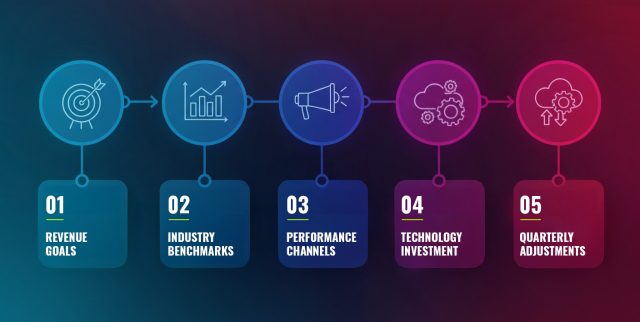
Five steps to smarter marketing performance and growth.
Final Thoughts: Align Spend With Growth
Budget season is your chance to reset priorities, focus on measurable outcomes, and prepare your brand for success in 2026. By emphasizing performance marketing, adopting AI-driven insights, and aligning corporate and local strategies, you’ll build a smarter, more accountable budget.
About Imaginuity
Imaginuity is a Dallas-based performance marketing company helping multi-location and franchise companies grow revenue. Imaginuity leverages Human Intelligence, Data Intelligence, and Artificial Intelligence to deliver measurable outcomes that drive leads and enterprise growth. Its proprietary platforms, AdScience ® and Pylot®, turn fragmented marketing efforts into scalable performance.

FAQ
Quick Answer:
Build your budget from revenue goals down. Fund proven channels, reserve for innovation, and track outcomes with attribution.
Expanded Answer:
Start with revenue goals and work backward—every dollar should be tied to growth objectives, not just last year’s spend. Prioritize proven performance channels such as SEO, paid media, direct mail, and emerging AEO/GEO strategies that ensure visibility in Google, maps, and AI-driven search. Reserve a portion of the budget for innovation and new technology adoption, like AI-powered content or predictive targeting. Use benchmarks and attribution tools to measure outcomes across every channel. This approach creates a budget that funds what works, scales across multi-location brands, and keeps marketing accountable to business growth.
Quick Answer:
Most multi-location brands spend 5–10% of revenue, with high-growth companies often investing more.
Expanded Answer:
Most multi-location and franchise brands invest 5–10% of revenue in marketing, balancing brand visibility with operational efficiency. High-growth companies often allocate more—especially in competitive markets or during aggressive expansion—to fuel lead generation, customer acquisition, and market share gains. Within that spend, prioritize channels that deliver measurable ROI, including SEO, paid media, and direct mail, while investing in AEO and GEO strategies to ensure your brand shows up in Google, maps, and AI-powered search results.
Quick Answer:
Performance marketing ties every dollar to measurable outcomes like leads, conversions, and ROI—essential for 2026 budget planning.
Expanded Answer:
Performance marketing ensures every marketing dollar is accountable by directly linking spend to outcomes such as leads, conversions, and ROI. During budget season, this accountability is critical—especially for multi-location and franchise brands balancing growth with efficiency. By using performance marketing, businesses can justify investments to stakeholders, prioritize channels that deliver measurable returns (SEO, paid media, direct mail), and adopt AEO/GEO strategies that increase visibility in Google, maps, and AI-driven search. This makes budgets both defensible and growth-oriented for 2026.
Quick Answer:
Review results quarterly, shift spend to high-ROI channels, and scale back underperformers to stay flexible.
Expanded Answer:
Marketing teams should build flexibility into their 2026 budgets from the start. Conduct quarterly reviews to assess performance across all channels, then reallocate spend toward those driving the strongest ROI—whether that’s SEO, paid media, direct mail, or AEO/GEO strategies that increase visibility in maps and AI search. Scale back areas that underperform, and reserve a portion of budget for testing new tactics as consumer behavior evolves. This approach keeps your marketing budget responsive to market shifts, competition, and emerging opportunities, while ensuring accountability to growth goals.